
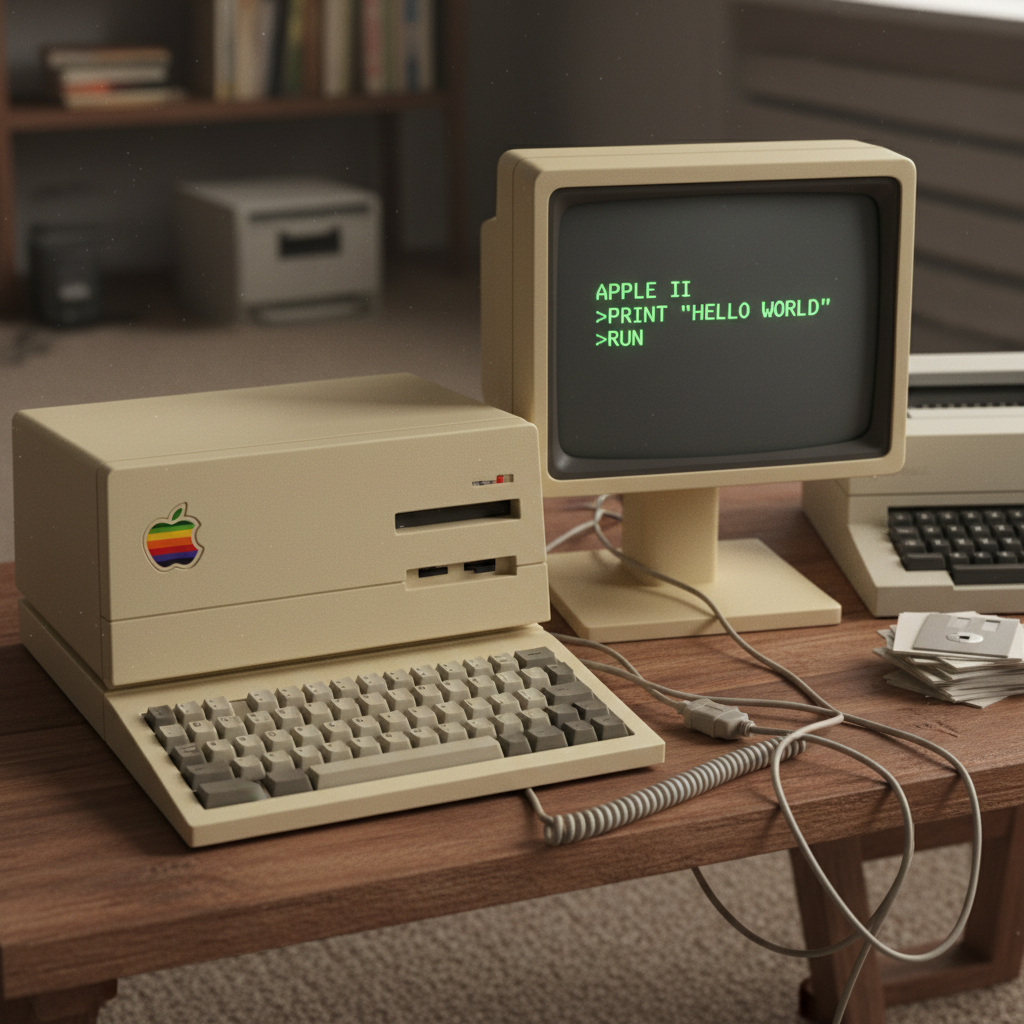
In 1977, Steve Wozniak did something that most engineers said was impossible on a budget: he built a color personal computer that regular people could actually use.
The Story
The Apple II wasn't just a computer — it was a statement. While competitors sold machines that came in kits for hobbyists to solder together, Apple sold a complete, ready-to-use device in a sleek plastic case with a color display.
Steve Wozniak's engineering on the Apple II was genuinely revolutionary. He figured out how to generate color graphics using a trick that exploited a quirk in how NTSC TV signals work — a technique so clever that it saved thousands of dollars in hardware costs and left other engineers scratching their heads.
The machine launched at the West Coast Computer Faire in April 1977 alongside the Commodore PET and the TRS-80. But while the others looked drab and industrial, the Apple II gleamed. It had color. It had a keyboard. It had slots for expansion cards. It even had a game paddle port.
VisiCalc, released in 1979, made the Apple II a business machine. It was the world's first spreadsheet program, and suddenly companies were buying Apple IIs just to run it. The computer that seemed like a toy became a tool that changed how businesses operated.
By the time the Apple II line was discontinued in 1993, Apple had sold over 6 million units across all variants — an extraordinary run of 16 years for a personal computer.
"My whole life I had been designing things without money. The Apple II was the culmination of that."— Steve Wozniak
Key Specs
Fun Facts
Wozniak designed the entire hardware himself — Jobs handled business and aesthetics.
The Apple II was used in schools across America throughout the 1980s and early 1990s.
Oregon Trail, one of the most famous educational games ever, became iconic on the Apple II.
The Apple II's architecture was so open that over 16,000 software titles were eventually released for it.
Legacy
The Apple II proved that personal computers weren't just hobbyist toys — they were tools that could transform work, education, and creativity. It laid the foundation for Apple as a company and for the entire PC industry.